Search results for tag #ipv6
![[?]](https://ipv6.social/system/accounts/avatars/109/264/914/124/733/601/original/d445ad99089fb700.jpg)
>>You can simply become the owner of an Internet address block.
Problem solved.
It's the networking equivalent of complaining about your hotel bill and being told:
"Have you considered buying the hotel?"<<
https://www.linkedin.com/pulse/ipv6-going-save-internet-any-day-now-manoj-joshi-w6lbc
![[?]](https://cdn.tenforward.social/accounts/avatars/113/478/419/701/443/766/original/67e87677e8793fa1.png)
@cwebber FYI your web server doesn't appear to be listening on #IPv6:
$ curl -Iv --connect-timeout 10 https://dustycloud.org/
* Host dustycloud.org:443 was resolved.
* IPv6: 2600:3c03::f03c:92ff:fe97:da3c
* IPv4: 45.79.144.54
* Trying [2600:3c03::f03c:92ff:fe97:da3c]:443...
* Trying 45.79.144.54:443...
* Immediate connect fail for 45.79.144.54: Network is unreachable
* Connection timed out after 10002 milliseconds
* closing connection #0
curl: (28) Connection timed out after 10002 milliseconds
![[?]](https://media.infosec.exchange/infosec.exchange/accounts/avatars/000/070/798/original/d20ead2f85c91066.jpg)
Of course #Verizon's support starts with a stupid AI chatbot. Pretty clear how bad their ipv6 documentation is when a chatbot trained on it comes up empty.
#ipv6
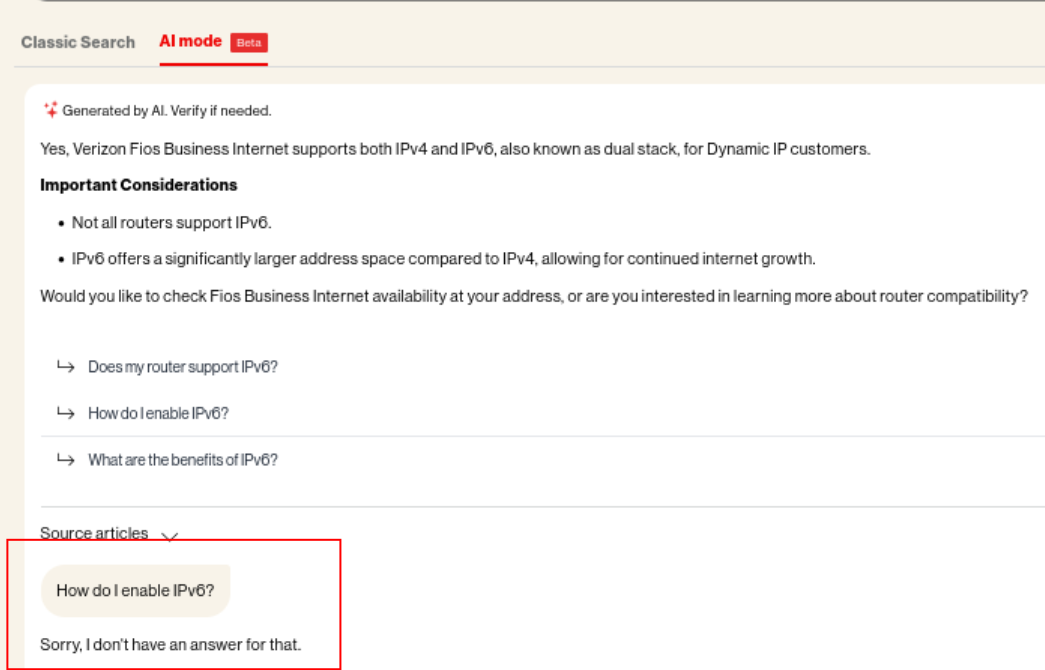
Alt...
Screenshot of an "AI mode" search at Verizon's help page. I searched just "ipv6". One of the suggested follow up questions, that is: a question the AI suggested that I ask, is "how do I enable ipv6?" And the AI responded "Sorry I don't have an answer for that."
I really need to learn #ipv6 better. At the house, I have a Verizon business line (not their residential service). I've got dedicated ipv4 addresses. I also have an ipv6 range that gets mapped by them.
The same line runs my ISP stuff and I'm trying to do a bit of segmentation. At first I thought I'd get a hurricane electric range, because it would be stable. I could count on it. Silly me, I went and got 3 HE ranges assigned to 3 different segments. That's dumb and the router doesn't like it.
I'm winding down the HE tunnels. That doesn't seem to be very effective. But I'm not sure (a) how to configure my #mikrotik to pick up whatever v6 range my ISP is sending, and (b) partition it into a couple predictable ranges. I think they delegate a /64. and then (c) assign those ranges to certain sets of systems. (They're already segregated on IPv4 /24s)
I also don't know how stable the Verizon assignment is. I'm nervous about possibly publishing AAAA records for stuff only to find that VZ delegates a new prefix one day and all that stops working.
I really want to learn, but there's so much randomness introduced by ISPs who don't document how stuff works.
Stumbled across https://centerclick.com/ntp/
I love the attitude:
> Cloud-Free Technology
> No stupid App, No online accounts, No subscription service, No Internet needed
Also looks to have full #IPv6. I'd be hard pressed to homebrew something like that for much cheaper. 🤔
![[?]](https://ipv6.social/system/accounts/avatars/111/296/888/673/560/456/original/374470677fbb1c2c.png)
Does anyone know if there's still someplace to obtain a small sliver of GUA #IPv6 address space? I remember this one from a while back by @cr : https://chaos.social/@cr/111805093462604493
I figure it'd be interesting to use GUAs for routing on #dn42 , neatly avoiding any issue with prefix collisions.
RE: https://the.goofs.space/@Gynux/117117680591907233
New #IPv6-only goofiness just dropped
Thomas Schäfer boostedJust in case some are in the mood to do something unproductive, I have added a few things in the wabbit maker :)
(ipv6 needed)
https://rabbits.gynux.com/
![[?]](https://the.goofs.space/system/accounts/avatars/000/000/002/original/72e776614b5a0cb8.jpg)
![[?]](https://ublog.mroach.com/fileserver/01K80SW66201KC2DKD6MF2NYVB/attachment/original/01KBA8W3W9T5VVHV0AB9SE9TYR.png)
I may or may not have just bought a pocket PC so I could add another user agent to my collection.
And fun surprise: it supports IPv6 out of the box! Windows Mobile 2003 SE had its act together.


Said ISP upon being asked when to expect customer #IPv6 availability: "As our current needs are met by IPv4, this is not a priority at the moment."
Wow, I haven't heard that line in 12 years: https://blog.flyingpenguintech.org/2014/03/a-call-to-isps.html
![[?]](https://ipv6.social/system/accounts/avatars/113/736/943/907/071/758/original/9b264b404e9802f0.png)
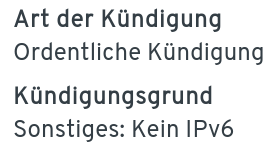
From an ISP this very morning: "We do not have customer #IPv6 available at this time."
It's the "at this time" that really bugs me. It's one of those phrases that people say because it sounds "proper" without thinking about it.
The "IPv6: No Longer Optional" talk was in 2010. RFC 6540 and World IPv6 Launch was in 2012. At _this_ time? What have you been doing with all the intervening time?
![[?]](https://gyptazy.com/fedi/gyptazy/s/avatar-1aa83a84ee47c864bc90216a89d0efcf.png)
I just adjusted my relay instance which now also finally supports #GoToSocial! Of course, it also supports Pleroma, snac, Mastodon, littlefedi, starling and many other ones!
With relays, your own posted content gets distributed to all connected instances, as well you get the content all other instances. Currently, mostly tech related instances are connected, focusing on #Linux, #Proxmox, #BSD / #FreeBSD, #IPv6 and many other things!
More information at: https://fedi-relay.gyptazy.com
#socialmedia #fedi #fediwall #fediverse #activitypub #activitypubrelay #relay #social #snac #snac2 #mastodon #gts #gotosocial #littlefedi #pleroma #misskey #services #devops #starling #tech
Friendly reminder: When configuring nginx server blocks, you have to explicitly listen on both address families:
listen *:80;
listen [::]:80;
Many examples I've seen only include the first line. If you don't include the second line, I will get a Connection Refused trying to reach your site. Happy Eyeballs will paper over this if you're dual stack, but on a single stack network I'm stuck not being able to see your content.
(so as to avoid That Guy™ getting in my replies: listen [::]:443; for HTTPS)
![[?]](https://media.hachyderm.io/accounts/avatars/109/304/228/003/988/176/original/0d18d3bec714f228.jpg)

For those relying on #IPv6 in production and using long uptime systemd-networkd, there is an integer overflow bug in some versions where the RA assignment will flap every five minutes following 497 days of uptime.
This is fixed in v250 but does NOT appear to have been backported to Ubuntu 22.04 which is exposed to this. Fix is in:
commit 16bc8635d551f73cdd9cf5c9d452f3ad9c34e9e4 from Oct 21 2021 ("network: address: use usec_t for handling lifetime")
![[?]](https://wybt.net/system/accounts/avatars/109/258/731/234/631/444/original/165e765a192047e6.jpg)
![[?]](https://media.mas.to/accounts/avatars/109/693/852/867/761/386/original/44b459cfb2a9a552.jpeg)
@quux #IPv6 Resources is 3 years old, today :)
https://gitlab.com/jenslink/ipv6-resources

Alt...
Window screenshot from IPv6 Resources GitLab page, where it highlights the creation date: August 11, 2023
![[?]](https://files.mastodon.social/accounts/avatars/109/246/658/555/377/525/original/55ce644601f543c9.jpg)
NAT should have been dead with globally routable #IPV6 addresses but here we are.
![[?]](https://assets.chaos.social/accounts/avatars/000/064/046/original/8b34ae5e2f43d354.png)
Note to self: Just don't touch #ipsec. It's shit all way round and always breaks. Just use something else.
Why?
Every time I want an encrypted tunnel between two public IPs I think like "oh yea, using IPSec here would be easy and straight forward".
And then it never fucking works reliably. And if it does work it stops to work the next time you try to apply the exact same config. And it fails with shit like this...
What have I done wrong?!? Why work sometimes??


Some day I'm going to give an Intro to Networking talk using just #IPv6 and when somebody inevitably presses me to talk about IPv4 I'll be like "Well, yeah, that's how we did it when I was a kid."
Silly mozilla:
[ERROR crashreporter::glean::uploader] failed to send glean ping: process failed (exit status exit status: 7) with stderr: curl: (7) Failed to connect to incoming.telemetry.mozilla.org port 443 after 2 ms: Could not connect to server
I guess the ultimate way to avoid being tracked is to go #IPv6-only.
OK, for better or worse, AMPRNet is still really hanging on to those 44Net IPv4 addresses. Now I know that 6to4 as a wider concept has been largely set aside primarily because of the anycast gateway issues, but I'm wondering if it could still be used to help this specific audience get familiar with the underlying concepts before graduating to real IPv6 addresses.
So, 2002::/16 isn't announced anymore because of aforementioned anycast issues, but could a subset of it still be announced? Consider, 44Net consists of
44.0.0.0/9
44.128.0.0/10
This translates into 6to4 prefixes of
2002:2c00::/25
2002:2c80::/26
Since ARDC already announces those v4 prefixes largely for the purpose of encapsulating them (44Connect, IPIP, etc), could they announce those v6 prefixes in the same vein? It seems quite feasible, so what weird edge cases am I missing?
![[?]](https://media.burningboard.net/accounts/avatars/109/892/422/024/311/931/original/f22e604f554272c0.png)

Nice!
Our Mastodon instance burningboard.net has almost 60% of total traffic using the current generation of the Internet Protocol (IPv6) and only arround 40% still using the legacy-protocol from the 1980s (IPv4).
Measured on the PF firewall of our Mastodon webserver over the last 48 hours.
#mastodon #ipv6 #internet #sysadmin #mastoadmin #fediverse
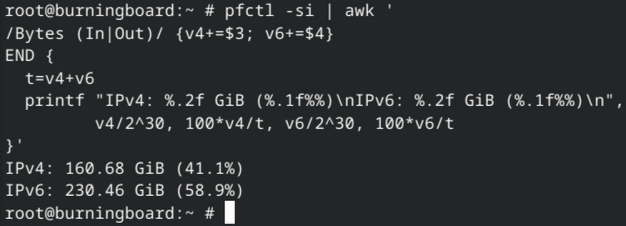
Alt...
Terminal screenshot running a shell command pipeline (pfctl -si | awk) that calculates IPv4 vs IPv6 network traffic on a server. The terminal output displays IPv4 traffic at 160.68 GiB (41.1%) and IPv6 traffic at 230.46 GiB (58.9%).
Crazy that IPV4 blocks are still so valuable while they should already have been relegated to the trash.
🗑️
Goodness! Someone's been busy.
https://game.flyingpenguintech.org/
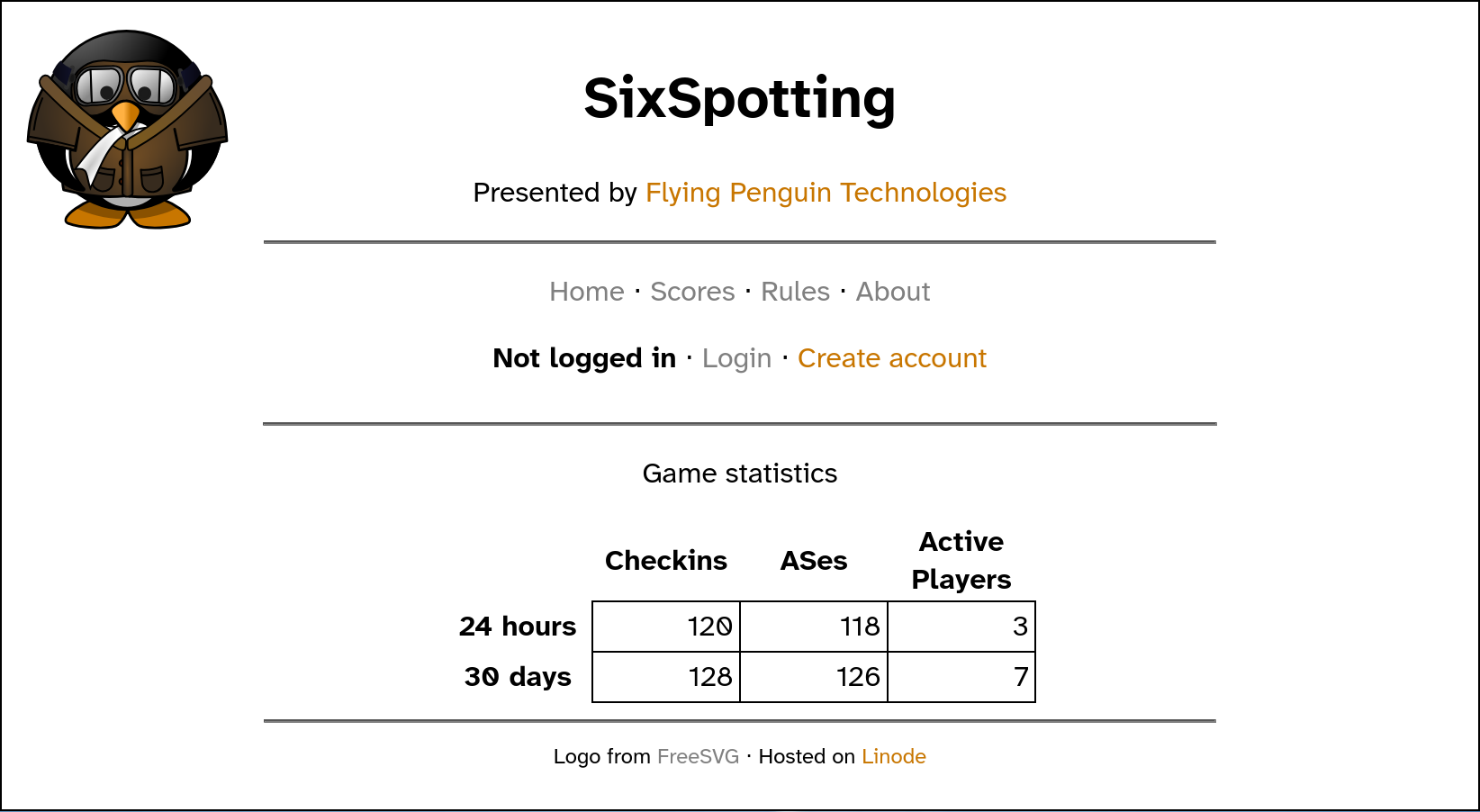
Alt...
The front page of SixSpotting with current statistics:
In the last 24 hours, 120 checkins from 118 ASes by 3 players
In the last 30 days, 128 checkins from 126 ASes by 7 players
![[?]](https://cdn.masto.host/socialisp6net/accounts/avatars/116/912/817/724/552/325/original/8c4a9ddcea29820b.png)
Reverse DNS (PTR) is where a lot of people give up on IPv6.
The addresses are long. The nibble format is fiddly. Mail servers still check it.
The fix isn't cleverness. It's delegation done once, correctly. Point the zone at your own nameservers, then generate the reversed-nibble records instead of counting them by hand.
Good reverse DNS is invisible. That's the whole point.
A /44 is sixteen /48s and one reverse zone. Eleven nibbles, not twelve.
5 of my 6 most recently filed issues on GitHub are "Please turn on IPv6 on your Github Pages hosted site":
https://github.com/cbor/cbor.github.io/issues/115
https://github.com/SeaGL/seagl.github.io/issues/495
https://github.com/coredotradio/core.radio/issues/1
https://github.com/lynn/hello/issues/152
https://github.com/glowing-bear/glowing-bear/issues/1300
4 of those have been crickets 🦗. 1 responded with "Patches welcome" to a repo that didn't actually have the code that supposedly needed patched.
This shouldn't be so difficult.
It's amusing to me that the first responses to FOSDEM announcing their WiFi will be #IPv6 only were that people will just tether to their cellphones to get out. Here in the US, if you're fortunate enough to get venue WiFi that doesn't cost a day's wages, it will almost assuredly not have any IPv6. This means I have to tether to my phone which does have IPv6 to reach my services.
Also, to anyone complaining about a network that can't reach the legacy Internet: What? 15 years lead time wasn't enough for you? (I refer to RFC 6540 and World IPv6 Launch Day in Q2 2012.)
They still set wrong priorities 🤦
https://docs.google.com/document/d/1RZWbM8taOIp9TMlk4Ftrq5Ku6bDm0x9sp6DJibtC3wA/mobilebasic
I spent more time than I care to admit doing dual-stack IP detection in a way that works on modern browsers and all the way back to Internet Explorer 6.
I learned that IE6 will refuse to do XHR unless the host+port are identical to the current URL, and it doesn't support CORS. So, the workaround was using JSONP.
I wonder how many other people in the world have IE6 running with IPv6 support...
#ipv6 #internetexplorer #windowsxp

Alt...
Screenshot of Internet Explorer 6 showing both IPv6 and IPv4 connectivity status